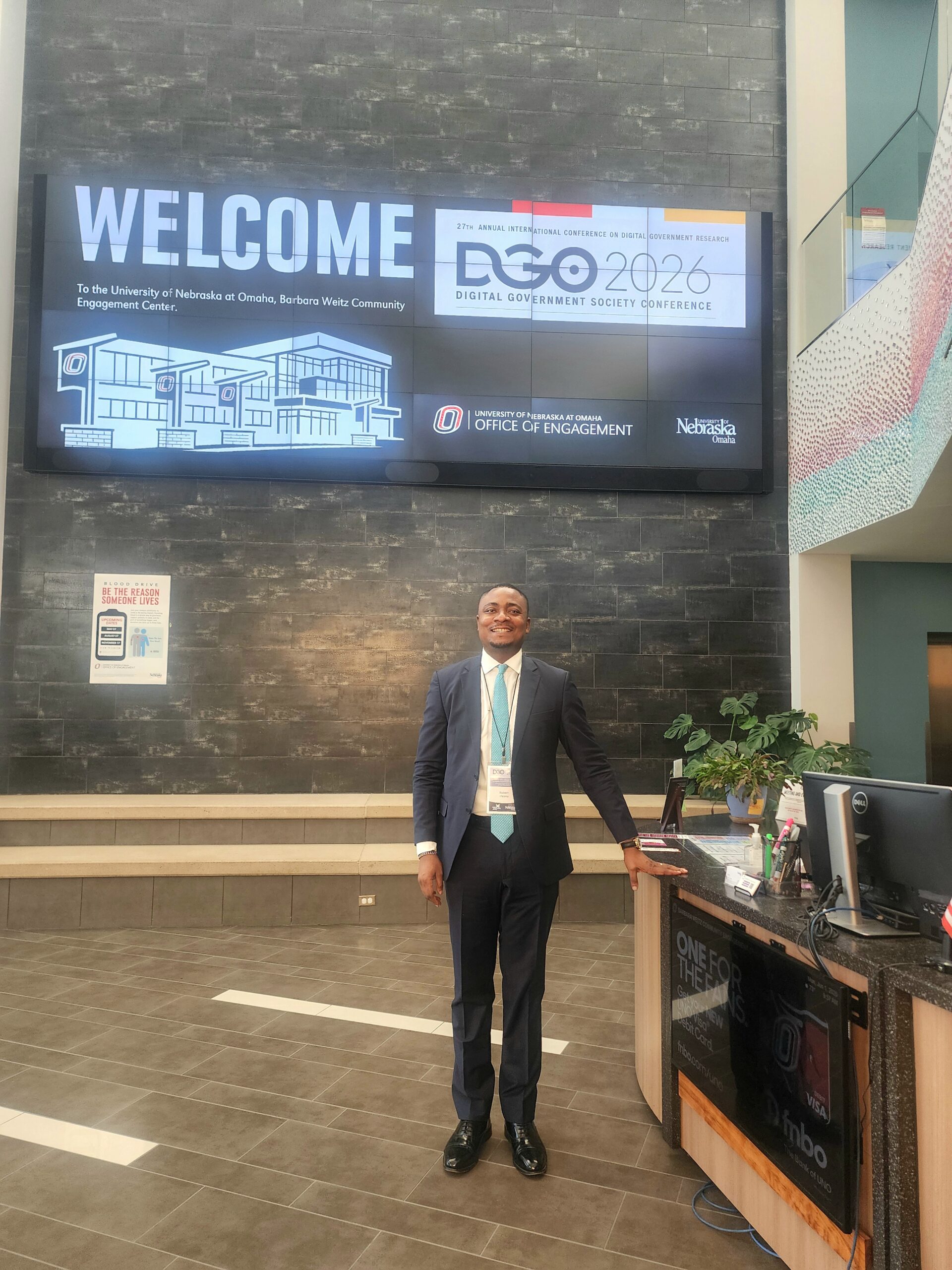
Reflections from Robert Ifeonu (Dg.o 2026 Travel Grant Awardee, Professional from the Central Bank of Nigeria (CBN))
First time’s the charm
When I finished writing my manuscript for dg.o 2026, I had a clear sense of what I was trying to argue but genuine uncertainty about how its positioning within the wider digital government research and practice. The paper introduced Transformation Velocity, a framework for thinking about how the pace of digital government reform must align with institutional capacity, political ambition, and operational readiness. It felt like a new lens on an old problem, and I was both enthusiastic and anxious to see how it would be received by the community. In many ways, that tension mirrored my own uncertainties about attending the conference itself.
It would be my first time at dg.o and only my second time in a room full of digital government scholars, after ICEGOV 2025 in Abuja. I was excited to be back among the minds wrestling with the world’s pressing digital governance questions. But I was also quietly curious about how the experience would play out for a first-timer and whether it would be worth it in the end.
Glad to say dg.o exceeded every expectation.
There is a particular energy to dg.o that is hard to fully describe. It is poised when researchers present new angles to stubborn problems with clarity and confidence, and electric when an idea lands with the audience and sparks new enquiries, new ways of thinking, and new angles for further work. Being part of that dynamic gives you a certain jolt, especially as someone who occupies both the research and practice domains. dg.o intentionally gave room for both and I found myself constantly toggling between my researcher lens and my practitioner lens, which is itself a sign of how rich the conversations were.
The litmus test for any community is the calibre of its people. What I found especially meaningful was the chance to interact with a multigenerational community of scholars. For researchers from the Global South, the authors of seminal and field-shaping work can feel almost abstract. Names on papers. Ideas you synthesise and build on without any real sense of the person behind them. dg.o 2026 closed that gap with real intentionality. Whether it was a brief exchange or a multi-day conversation that evolved across sessions, getting a glimpse behind the curtain of the minds forging these ideas was genuinely humbling. There is probably some wisdom in the saying that you should never meet your heroes. However, I would absolutely recommend meeting the people you cite.
The breadth of the programme was ambitious enough to make any schedule taut, but the itinerary never buckled under its own weight. Presentations spanning AI for crisis management, mindfulness as a governance parameter, agritech solutions, and GovTech applications could easily have been a dizzying experience. When elevated minds come together though, the depth tends to hold. One highlight was the junior faculty session, which evolved into something genuinely multidimensional. Young researchers, seasoned mentors, and curious practitioners all trying to find a niche that represents their voices within the community. I think they all found a seat at the table.
As for my own presentation, I watched the room shift in real time. From curiosity, to interrogation, to genuine insight. It was a reception I had hoped for but also underestimated. The niggling problem I had been trying to diagnose was not an outlier. Scholars in the room had encountered it in Italy, in Canada, across the globe. The questions and ideas that followed will now serve as a guide for the many directions this work can take. That exchange alone made the journey worthwhile.
It would also be remiss not to say something about Omaha. I spent a week in the city and the tales about Midwest hospitality are entirely true. It shows up everywhere, in an Uber ride, at a shopping mall, in the way strangers hold a conversation. On the last day of the conference, I asked my Uber driver why everyone just seemed so genuinely warm. He replied “It just comes easy. That’s the Midwest.” It felt like a poetic end to a defining conference. I left with a head full of ideas and the warmth of a city that had welcomed us with open arms.
dg.o 2026 is over. But the ideas shared, the friendships made, and the partnerships created will persist long after the University of Nebraska closes the curtain, switches off the lights, and rearranges the furniture for the next scholarly endeavour. That is exactly the kind of thing that keeps this community alive and thriving. It’s also what turns a first timer into a repeat attendee.
See you in Seoul 2027.
