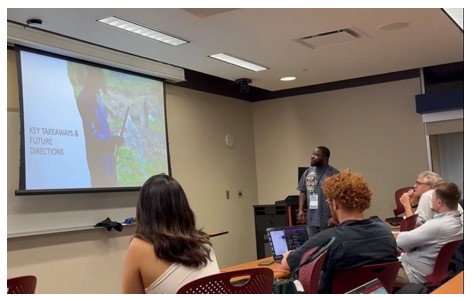
Reflections from Kingsley Ofosu-Ampong (Dg.o 2026 Travel Grant Awardee – Scientist at Alliance of Bioversity International & CIAT, Ghana)
The 27th Annual International Conference on Digital Government Research (dg.o 2026), held from 1–4 June 2026 at the University of Nebraska Omaha, USA, brought together scholars, practitioners, policymakers, and digital innovation leaders to reflect on the future of governance in an increasingly digital and AI-enabled world.
Under the theme “Collaborative Digital Transformation for Public Value Creation,” the conference provided a timely platform to examine how emerging technologies can strengthen public institutions, improve service delivery, and address complex societal challenges. Across the keynote presentations, panels, and research sessions, one message was clear: digital transformation must go beyond technology adoption. It must be guided by public value, ethical governance, accountability, inclusion, and trust.
Discussions on AI-driven government emphasized the need for robust policy frameworks that balance innovation with transparency, privacy, and public responsibility. Sessions on research universities further highlighted the importance of deliberate AI strategies that can transform teaching, research, institutional operations, and workforce preparation. A recurring theme throughout the conference was that digital transformation should be inclusive and citizen-centered, ensuring that technological advances help reduce inequalities rather than deepen them.
It was both an honour and a privilege to contribute to this global conversation through the presentation of our accepted paper, “Co-developing and Scaling Climate-Smart Digital Agro-Advisories: A Multi-Institutional Framework from Ghana.” The paper responds to a pressing challenge in Ghana’s agricultural sector: how to move beyond incremental improvements and reimagine the way agronomic knowledge is generated, delivered, and adapted in response to climate variability and changing production realities.
Developed through a collaboration involving CSIR-INSTI, CSIR-Crops Research Institute, CSIR-Soil Research Institute, the Ministry of Food and Agriculture, and the Alliance of Bioversity International and CIAT under CGIAR’s Sustainable Farming Programme, the initiative demonstrates the value of multi-institutional partnerships in advancing climate-smart digital agriculture.
At the centre of the work is a climate-smart cropping calendar and bundled agro-advisory system that integrates real-time climate information, localized soil diagnostics, crop growth intelligence, and behavioural insights. Rather than serving as a conventional scheduling tool, the system functions as a dynamic decision-support platform that delivers timely, site-specific, and actionable recommendations to farmers and extension actors.
A key strength of the framework is its participatory and human-centred design. By engaging researchers, extension agents, government institutions, and farmers throughout the design and validation process, the system promotes shared ownership, local relevance, and long-term sustainability. Early scaling across Ghana’s diverse agroecological zones shows how digital advisory services can strengthen resilience, improve knowledge access, and enhance the effectiveness of extension systems.
The Ghana experience offers important lessons for agricultural transformation across sub-Saharan Africa. It shows how digitally enabled, climate-responsive, and farmer-centred advisory ecosystems can be built through strong institutional collaboration, evidence-based design, and continuous learning. As countries seek to modernize extension services and strengthen climate resilience, this framework provides a scalable model for national adaptation efforts, regional learning, and South-South collaboration.
Presenting this work at dg.o 2026 reinforced my conviction that digital public goods, responsible innovation, and co-created advisory systems have a vital role to play in building more resilient, inclusive, and sustainable food systems. The conference was a powerful reminder that the future of digital governance lies not only in advanced technologies, but in how those technologies are designed, governed, and used to create meaningful public value. I am also sincerely thankful to the dg.o Board for the grant that made it possible for me to travel from Ghana and attend the conference. Their support embodies dg.o’s core mission of reducing inequalities and strengthening social cohesion through inclusive digital governance.
