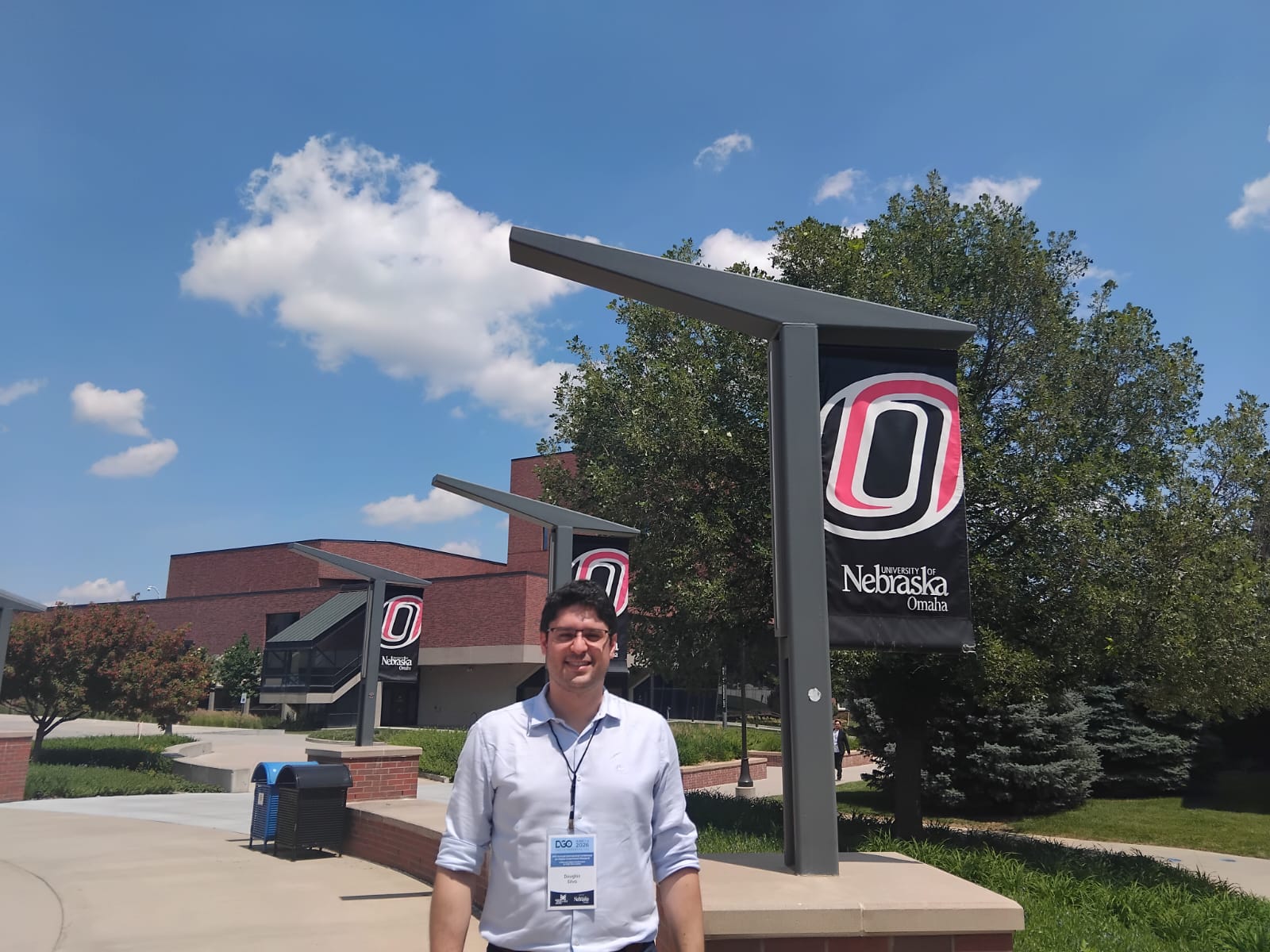
Reflections from Douglas Bernardes Silva (2026 dg.o Travel Grant Awardee, Ph.D. in Computer Science from the Federal University of Goiás, Brazil)
From Tax Fraud Detection to Responsible AI: Reflections on my First dg.o Conference
This was my first time attending dg.o, and it was a remarkable experience both academically and personally. I came to Omaha to present my paper, “Multi-Aspect Ensemble Learning for Detecting Structured Fraud in Goods and Services Trading,” developed with Nadia F. F. da Silva and Sergio T. Carvalho at the Federal University of Goiás, Brazil.
My research addresses a practical challenge faced by tax administrations: how to identify structured fraud schemes supported by shell companies and fictitious invoices in large-scale transactional environments. In Brazil, tax administrations work with massive volumes of electronic tax data, but the detection of sophisticated fraud is not only a technical challenge. It is also an institutional, operational, and public value challenge. Our paper proposes a hierarchical multi-aspect ensemble learning architecture that separates different dimensions of taxpayer behavior, such as registration, restrictions, commercial operations, tax assessment consistency, and payment behavior, and then integrates their outputs into a fraud-risk score.
Presenting this work at dg.o was especially meaningful because the conference brought together exactly the kind of interdisciplinary community that this type of research needs. The discussions were not limited to machine learning performance or technical innovation. They also addressed accountability, governance, human judgment, public values, institutional capacity, and the risks involved when artificial intelligence is used in public sector decision-making.
One of the strongest impressions I took from the conference is that artificial intelligence in government should not be treated as a magic solution. AI is most valuable when applied strategically to concrete problems in which scale, complexity, or operational constraints make manual analysis inefficient or unfeasible. At the same time, the conference made clear that governments need to be careful about when and how AI is introduced. Decisions that affect citizens’ rights, access to services, obligations, or opportunities require transparency, human oversight, institutional responsibility, and clear governance mechanisms.
Several sessions reinforced this point. The keynotes and paper sessions discussed how governments around the world are dealing with digital transformation, AI governance, cybersecurity, data governance, and public sector innovation. I was particularly interested in the discussions on preserving human judgment in AI-assisted decisions, the risks of bias in generative AI, and the importance of institutional capacity for responsible AI adoption. These debates helped me think more clearly about how AI tools can support public administration without replacing the responsibility of public officials.
I was also impressed by the diversity of the dg.o community. I had the opportunity to meet researchers and practitioners from different countries, disciplines, and institutional backgrounds. The Brazil Chapter meeting was another highlight, as it brought together Brazilian researchers working on digital government from many universities and organizations. For someone attending dg.o for the first time, this sense of community was very important.
Another valuable aspect of the conference was seeing how applied research can remain rigorous while still being closely connected to real-world public problems. Many discussions throughout the event showed that digital government research is not only about building systems or analyzing technologies. It is about understanding how technology interacts with institutions, people, rules, values, and public needs.
I return from dg.o 2026 with new research ideas, new connections, and a stronger understanding of the challenges involved in using AI responsibly in government. The experience also reinforced my belief that tax administration, like many other areas of the public sector, can benefit from advanced analytics and artificial intelligence when these tools are designed with transparency, accountability, and institutional purpose.
I am grateful to the Digital Government Society, the organizers, the session chairs, and all participants who made dg.o 2026 such a welcoming and intellectually rich experience. I hope to continue contributing to this community in future editions.
