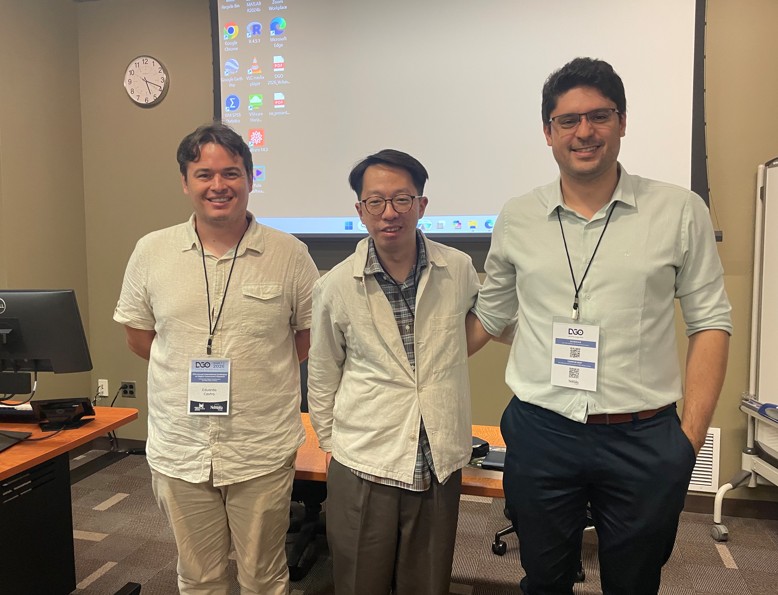
Reflections from Eduardo Castro (2026 dg.o Travel Grant Awardee, Ph.D. Student at University of Brasília, Brazil)
This was my first time attending to dg.o and I went to present my research “Low-Code for Institutional Capacity and Collaborative Digital Government in Brazil”, developed during my Master’s in Applied Computing at the University of Brasília under the advisory of Prof. Rejane Figueiredo.
The paper looks at how Brazilian public organizations adopted Low-Code Development Platforms (LCDPs) and the outcomes derived from those adoptions based on survey data we collected from 61 federal, state and municipal public organizations through Brazil’s Access to Information Law. We focused on this topic because public organizations everywhere face IT workforce shortages and development bottlenecks while dealing with constant pressure and growing demand for digital services and LCDPs may be a viable answer to those gaps.
We found that LCDPs accelerate digital transformation in the public sector, as stated by 92% of respondents, and reduce the time and the cost of developing digital services, as stated by 79% of respondents. Besides those positive factors, organizations that adopt low-code need to deal with vendor lock-in, which is a prominent risk for the public sector. Our work shows that Low-Code Development Platforms does contribute to building institutional capacity for digital transformation, but there are trade-offs that public organizations chasing short-term gains need to consider and address.
Presenting it abroad, in my second language, was a challenge that I was happy to overcome. The questions afterward were interesting and some of them have already influenced my ideas for the next stage of the research, hopefully during my doctoral studies. I met students who were also presenting for the first time and approached senior researchers and professors I was very glad to meet and connect with. I’m optimistic that many of the connections will lead to research and work opportunities that I hope to present in future editions of dg.o.
What surprised me most was the intellectual richness that comes from gathering so many digital government specialists from such complementary fields like computer science and public policy. I was also genuinely moved by the community and all the warm reception that I received throughout the conference.
I learned a lot and was very interested in the discussions around the impact of AI in the public sector with Prof. M. Jae Moon, Prof. Theresa Pardo and many others. I also want to highlight the Brazilian community who made me feel at home and supported me during the whole conference.
I’m grateful to the Digital Government Society for the opportunity and for the travel grant that made my participation possible. For a master’s student, getting to show my work in front of this particular crowd and getting to learn from and to connect with so many great people is hard to overstate. I am coming home with a long reading list, a lot of people to follow-up with and a clearer purpose to keep up the hard work with my studies in digital government research.


Pingback: Aluno do PPCA é o vencedor do Prêmio de Auxilio de Viagem no DG.o 2026 – PPCA – Programa de Pós-Graduação em Computação Aplicada