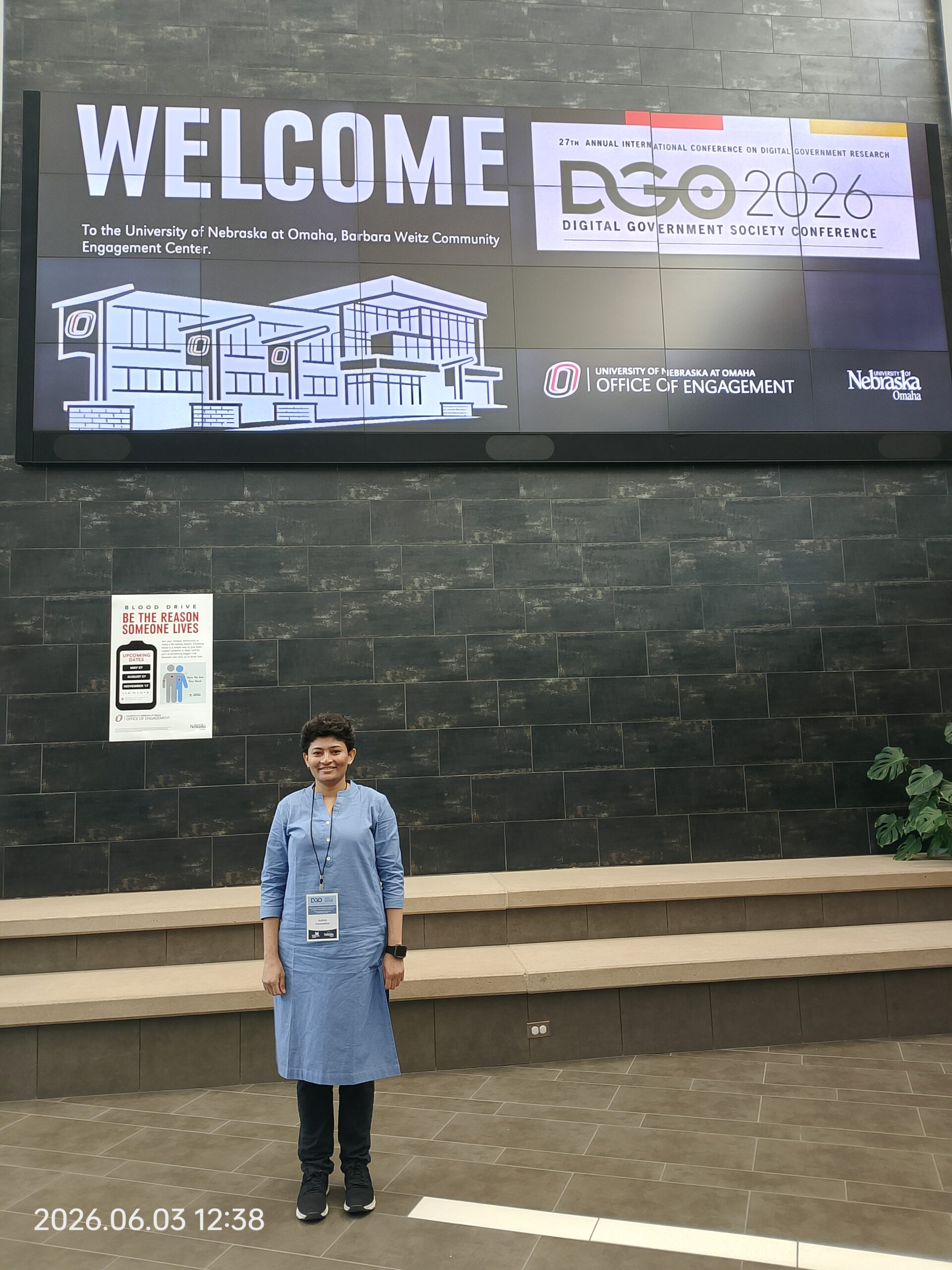
Reflections from Asilata Karandikar (Dg.o 2026 Travel Grant Awardee Ph.D. Candidate, International Institute of Information Technology Bangalore, India)
This was my first participation in the Digital Government Research conference and it was an excellent learning experience. I presented my paper titled, “The Institutional Underpinnings of Data Privacy: A Comparison of India and the European Union” in the Law, Technology, and Innovation Track. This work is part of my doctoral research under the supervision of Prof V Sridhar and Prof Srinath Srinivasa at the International Institute of Information Technology Bangalore.
In this paper, I conduct a comparative institutional analysis of India’s Digital Personal Data Protection Act, 2023, and the EU’s General Data Protection Regulation, 2016, as the point of entry, and delineate the constitution, regulation, and interrelationship of legal institutions underpinning data privacy. Using the Institutional Grammar method, I break down legal texts into their institutional components and quantitatively analyze these components to reflect on the nature of the state-citizen relationship. This paper demonstrates the underlying themes in the linguistic framing of data privacy laws through analyses of word frequencies, statistically significant keywords, and co-occurrence patterns in legal text. In the context of increasing digital participation in the course of everyday social and economic life, this paper draws attention to the resourcification of citizens’ data, which is leveraged by both, the private and the public sector. Building on literature on the need for a new social contract for digital data, this paper highlights the primacy of laws dealing with processing of personal data in shaping this transformation. Through its analyses of data privacy laws, it examines the contours of an emergent social contract between citizens-as-bearers-of-data, and the private and public entities which collect and process the data. In doing so, this paper demonstrates a novel approach in bridging the conversation on data privacy with literature on institutionalism and political theories of the social contract.
In the session, I received critical feedback from the chair, Dr. Diogo Sasdelli, on supplementing my research with legal hermeneutic approaches in the analysis of data privacy laws, as well as encouragement to expand on the methods outlined in the paper.
Throughout the conference, I listened to the work of researchers from the Global South and North and had engaging discussions with several scholars on the policy emphasis and strategies of digital government, and increasingly, deployment of AI, in their respective regions, and the comparison with the Indian approach of development of digital public infrastructures. The keynotes and panel discussions were interesting in their turn, and my only regret was that the tightly packed schedule of parallel tracks meant that I had to forego some of the sessions for attending others!
A standout experience for me was the half-day Junior Faculty School led by Prof Tomasz Janowski on the very first day of the conference. With its mix of doctoral scholars, young faculty, and mentors from academia and public policy, there was an infectious enthusiasm to it, which set the tone for the rest of the conference! The sessions led by Prof Panos Panagiotopoulos on publication strategies, and Dr. David Duenas-Cid on research grant applications gave a clear picture of the challenges as well as useful advice and strategies on these two important areas for us early career researchers. Mr. Mohamed Shareef’s session on real-world impact of research offered a fresh perspective on the urgency of research translation for policy advocacy, and strategies for proceeding to the next rung in the research to impact journey. His exhortation to frame our research differently for policy and academic audiences – to speak in different registers – gave me a fresh approach to think about my own work.
All in all, the conference was an unforgettable experience, not the least as it was my first visit to the US, and the warmth and hospitality of the people I met in Omaha made it a very pleasant one! My thanks to the organisers at the Digital Government Society and the University of Nebraska-Omaha for their efforts in making the conference a rewarding experience for the participants! I came back with new ideas, connections, and fresh motivation for my research.
